
Upon completion of filming our thriller, we decided to head straight into editing the piece and creating a soundtrack for it. We planned to do this by separating our group in two in order to maintain a high level of efficiency to achieve our production deadline.
One half of the group started on the editing while the other half started to create music for our soundtrack which was crucial for our piece as it was the vital element to give the thriller a much more professional look.
However, there were many adversities that we came across in both editing and the soundtrack. One of the problems in the editing stage was that in one of the point of view sequences the shadow of the camera and the actor were caught in shot, but even though we tried to cut it out it was not possible because it broke the continuity.
The other problem we had was creating a soundtrack. Although it was good it was hard to create a soundtrack for our piece as we created it on a different computer, therefore a lot of guesswork took place. Once we had finished editing our rough cut, we sent our film to the other computer making it possible for us to fit the soundtrack to the film.
Showing posts with label Gabriel Clarke. Show all posts
Showing posts with label Gabriel Clarke. Show all posts
Friday, 19 March 2010

Friday, 12 March 2010
Response to Rough Cut feedback
In response to our feedback, there are many comments which we will take action upon.
Firstly, our ending was actually unintentional, therefore our plan was to cut that part anyway.
Secondly, in regards to our piece being too bright we will use the color corrector in order to change the brightness to suit the mood of our piece more.
Finally, we will add a soundtrack to enhance the viewers experience of the thriller.
Firstly, our ending was actually unintentional, therefore our plan was to cut that part anyway.
Secondly, in regards to our piece being too bright we will use the color corrector in order to change the brightness to suit the mood of our piece more.
Finally, we will add a soundtrack to enhance the viewers experience of the thriller.
Feedback on Rough Cut
Camerawork:
-Good Variation of shots
Editing:
-The blending of images is effective.
- Cut the part where the guy is taking photos and put some of the writing bit in it as it is a bit long, this way it will be split up and less long winded.
Mise En Scene:
-Fake blood on injuries looks authentic. The costumes used realistic and there is good use of the camera. Attention to detail is good as the use of police tape makes it seem more realistic.
-It is naturally bright and could of been better with the use of effects such as colour corrector. -The contrast of locations is good as they have the field and the office which is good for the audience.
Sound:
-Good sound effects.
- It lacked soundtrack
- Its a good film but with a soundtrack it could be excellent.
-Good Variation of shots
Editing:
-The blending of images is effective.
- Cut the part where the guy is taking photos and put some of the writing bit in it as it is a bit long, this way it will be split up and less long winded.
Mise En Scene:
-Fake blood on injuries looks authentic. The costumes used realistic and there is good use of the camera. Attention to detail is good as the use of police tape makes it seem more realistic.
-It is naturally bright and could of been better with the use of effects such as colour corrector. -The contrast of locations is good as they have the field and the office which is good for the audience.
Sound:
-Good sound effects.
- It lacked soundtrack
- Its a good film but with a soundtrack it could be excellent.
Tuesday, 9 March 2010
Filming Report
Overall our day of filming was a success. Everyone turned up at the correct time and remembered any props/equipment they were responsible for. We managed our time well and made sure to film several versions of each shot. This allowed us to use the best version of every shot and make sure that the sequence looked its best. As we had carefully planned beforehand, we faced very few challenges. The main problem we faced was getting the right amount of movement whilst the camera was being dragged. If it moved too much then the viewer wouldn't be able to understand what is happening. If there was too little movement then the effect of being dragged would be lost. Another challenge we faced was the problem ensuring the viewer knew the first shot was a point of view shot. We solved this problem by showing the persons injured hand.


Thursday, 4 March 2010
Thriller Conventions
A crime at the core of the narrative (often murder, but not necessarily).
A complex narrative structure, with false paths, clues and resolutions.
A narrative pattern of establishing enigmas which the viewer expects to be resolved.
A protagonist who is systematically dis-empowered and drawn into a complex web of intrigue by the antagonist.
Extraordinary events happening in ordinary situations.
Themes of identity.
Themes of mirroring.
Themes of voyeurism.
Protagonist with a ‘flaw’ which is exploited by the antagonist.
Titles often reflect an aspect of the pro/antagonist’s psychological state.
There is often a scene near the end of the film in which the protagonist is in peril.
Mise en scene which echoes/ mirrors the protagonist’s plight.
A complex narrative structure, with false paths, clues and resolutions.
A narrative pattern of establishing enigmas which the viewer expects to be resolved.
A protagonist who is systematically dis-empowered and drawn into a complex web of intrigue by the antagonist.
Extraordinary events happening in ordinary situations.
Themes of identity.
Themes of mirroring.
Themes of voyeurism.
Protagonist with a ‘flaw’ which is exploited by the antagonist.
Titles often reflect an aspect of the pro/antagonist’s psychological state.
There is often a scene near the end of the film in which the protagonist is in peril.
Mise en scene which echoes/ mirrors the protagonist’s plight.
Evaluation Questions
1. In what ways does your media product use, develop or challenge forms and conventions of real media products?
2. How does your media product represent particular social groups?
3. What kind of media institution might distribute your media product and why?
4. Who would be the audience for your media product?
5. How did you attract/address your audience?
6. What have you learnt about technologies from the process of constructing the product?
7. Looking back to your preliminary task, what do you feel that you have learnt in the progression from it to the full product?
2. How does your media product represent particular social groups?
3. What kind of media institution might distribute your media product and why?
4. Who would be the audience for your media product?
5. How did you attract/address your audience?
6. What have you learnt about technologies from the process of constructing the product?
7. Looking back to your preliminary task, what do you feel that you have learnt in the progression from it to the full product?
Tuesday, 2 March 2010
Target Audience
The target audience for our thriller is the teenage and young adult market. This is because our thriller may be deemed unsuitable for a younger audience. Our film would appeal to people who have previously seen and enjoyed thrillers. The BBFC rating we will use will be 15. This is because we feel that this is the best rating as it gives us a much larger potential audience, while still giving us the opportunity to explore more adult themes and contain more violent, potentially distressing images.


Thursday, 25 February 2010
Evaluation Questions
1. In what ways does your media product use, develop or challenge forms and conventions of real media products?
2. How does your media product represent particular social groups?
3. What kind of media institution might distribute your media product and why?
4. Who would be the audience for your media product?
5. How did you attract/address your audience?
6. What have you learnt about technologies from the process of constructing the product?
7. Looking back to your preliminary task, what do you feel that you have learnt in the progression from it to the full product?
2. How does your media product represent particular social groups?
3. What kind of media institution might distribute your media product and why?
4. Who would be the audience for your media product?
5. How did you attract/address your audience?
6. What have you learnt about technologies from the process of constructing the product?
7. Looking back to your preliminary task, what do you feel that you have learnt in the progression from it to the full product?
Tuesday, 23 February 2010

Friday, 5 February 2010
Prop Responsibilities
Tom:
Fake gun, 'forensics suit', fake blood, waterproof trousers
Gabriel:
Stills camera, police tape, surgeons gloves
Victor:
Wellington boots,
Fake gun, 'forensics suit', fake blood, waterproof trousers
Gabriel:
Stills camera, police tape, surgeons gloves
Victor:
Wellington boots,
Thursday, 4 February 2010
Test for animation of Title Sequence
We wanted to replicate the jittery effect used in the title sequence of 'Se7en'. By using Final Cut, we managed to animate the text so it moved tiny amounts at a time. This was extremely time consuming, so if it is used in our opening we will make less individual movements and simply loop the piece.
Practice titles
As you want to keep the audience interested in the film, the opening sequence and titles are vital in keeping the audience's attention because it is the first few minutes of a film that can potentially reel them in for the whole movie.
There are four members in our group, so we are likely to include the four main titles in our credits. Here is an example of some of the titles we intend to use:
However, we are using it in the point of view sequence where Victor is falling in and out of consciousness. This allows us to fade in titles when drifting out of consciousness a few times, starting with titles such as Editor/Sound etc and then director. After the climax, (Being shot) the title of the movie will appear.
Consequently, we hope that, by adding in the titles during the tense moments it will give a professional look to it rather than just sticking them in at the end.
There are four members in our group, so we are likely to include the four main titles in our credits. Here is an example of some of the titles we intend to use:
- Director - Tom Snell
- Cinematographer - Gabriel Clarke
- Sound - Sade Mills-Isiorho
- Editor - Victor Mishra
However, we are using it in the point of view sequence where Victor is falling in and out of consciousness. This allows us to fade in titles when drifting out of consciousness a few times, starting with titles such as Editor/Sound etc and then director. After the climax, (Being shot) the title of the movie will appear.
Consequently, we hope that, by adding in the titles during the tense moments it will give a professional look to it rather than just sticking them in at the end.


Shot List
1 Point of View
Props: Sack
Being dragged, sack over camera simulating bag over head. Conversation can be heard, but is heavily distorted. Some light visible through sack.
2 Point of View
Props: Sack
The bag is removed, revealing isolated location. Fade out, showing character slipping out of consciousness.
3 Point of View
Props: N/A
Fade from black back to image, having moved to a new location. Still being dragged. Fade out again
4 Point of view/Canted Angle
Props: Gun
Fade back in. The camera is looking at the floor. Pans up at a canted angle, revealing a person sanding in front of the camera, pointing a gun. Pan up just short of revealing their face.
6 Close up
Props: Gun
Close up on gun, emphasizing barrel.
7 High angle/ Long shot
Props:Gun
Looking down on scene of imminent murder. This is the only time we see the character the POV shots were representing. As the shot is fired, the 'camera character' slumps forward. Fade to black, with the title fading in over the black.
9 Establishing shot
Props: Police Tape, Camera
Police tape strung between two trees in foreground. In background, forensic scientist taking photos of crime scene.
From here, all shots are only few frames in duration
10 Med. Shot
Props: Camera
Forensic taking photo of corpse.
11 Close up
Props: Photos of body
Close up of photos scattered on desk
12 Extreme close up
Props: Autopsy forms, Pens
Close up of forms being filled in. Focus on words linked to murder/injury, such as 'Homicide' or 'Damage'
Props: Sack
Being dragged, sack over camera simulating bag over head. Conversation can be heard, but is heavily distorted. Some light visible through sack.
2 Point of View
Props: Sack
The bag is removed, revealing isolated location. Fade out, showing character slipping out of consciousness.
3 Point of View
Props: N/A
Fade from black back to image, having moved to a new location. Still being dragged. Fade out again
4 Point of view/Canted Angle
Props: Gun
Fade back in. The camera is looking at the floor. Pans up at a canted angle, revealing a person sanding in front of the camera, pointing a gun. Pan up just short of revealing their face.
6 Close up
Props: Gun
Close up on gun, emphasizing barrel.
7 High angle/ Long shot
Props:Gun
Looking down on scene of imminent murder. This is the only time we see the character the POV shots were representing. As the shot is fired, the 'camera character' slumps forward. Fade to black, with the title fading in over the black.
9 Establishing shot
Props: Police Tape, Camera
Police tape strung between two trees in foreground. In background, forensic scientist taking photos of crime scene.
From here, all shots are only few frames in duration
10 Med. Shot
Props: Camera
Forensic taking photo of corpse.
11 Close up
Props: Photos of body
Close up of photos scattered on desk
12 Extreme close up
Props: Autopsy forms, Pens
Close up of forms being filled in. Focus on words linked to murder/injury, such as 'Homicide' or 'Damage'
Wednesday, 3 February 2010
Detailed Props List
Hessien Sack- This will be placed over the camera during the POV shots to create the illusion that the character has their head covered. Once removed, it will be visible on the ground throughout the rest of the sequence.
Gun- A replica BB gun will be used. It will feature in a variety of different shots, including the POV shots, a close up and a long shot.
Stills Camera- During the 'fast cut' sequence, the image of a forensic scientist taking photos of the crime scene we feature
Photos- Photos, presumably taken by the scientist, will show areas of the crime scene.
Warning Tape- Similar to the camera, this will feature in the 'fast cut' sequence.
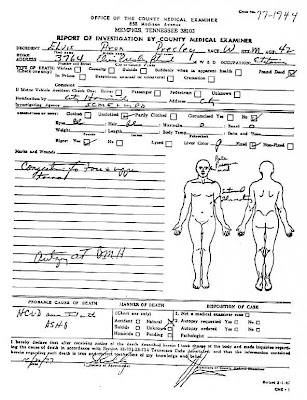
Autopsy/Police Forms- Again, during the 'fast cut' sequence we will see various police forms being filled out, with close ups on key words.
Gun- A replica BB gun will be used. It will feature in a variety of different shots, including the POV shots, a close up and a long shot.
Stills Camera- During the 'fast cut' sequence, the image of a forensic scientist taking photos of the crime scene we feature
Photos- Photos, presumably taken by the scientist, will show areas of the crime scene.
Warning Tape- Similar to the camera, this will feature in the 'fast cut' sequence.
Autopsy/Police Forms- Again, during the 'fast cut' sequence we will see various police forms being filled out, with close ups on key words.

Monday, 1 February 2010
How are titles used? -Gabriel Clarke
I feel that the opening credits for Sin City are very effective because they are not too complicated and they portray the origin of the film (the Graphic Novel), this also layered with a suitable tension building soundtrack wants us to watch on and find out what the characters shown in the background do and contribute to the story-line. The red text against the otherwise monochrome images add to a sense of danger and uneasiness.
We hope to replicated this simple yet effective opening credits by having our moving picture fading in and out in the background, much like Sin City.
Friday, 29 January 2010
Definition of thriller, outline of different sub genres and hybrids
Thriller - Thrillers are characterized by fast pacing, frequent action, and resourceful heroes who must thwart the plans of more powerful and better equipped villains.
Sub-genres
The thriller genre can include the following sub-genres, which may include elements of other genres:
- Action thriller: In which the work often features a race against the clock, contains lots of violence, and an obvious antagonist. These films usually contain large amounts of guns, explosions, and large elaborate set pieces for the action to take place. These films often have elements of mystery films and crime films but these elements take a backseat to action. Notable examples are the James Bond films, The Transporter, and the Jason Bourne novels and films.
- Conspiracy thriller: In which the hero/heroine confronts a large, powerful group of enemies whose true extent only he/she recognizes. The Chancellor Manuscript and The Aquitane Progression by Robert Ludlum fall into this category, as do films such as Three Days of the Condor, Capricorn One, and JFK.
- Crime thriller: This particular genre is a hybrid type of both crime films and thrillers that offers a suspenseful account of a successful or failed crime or crimes. These films often focus on the criminal(s) rather than a policeman. Crime thrillers usually emphasize action over psychological aspects. Central topics of these films include murders, robberies, chases, shootouts, and double-crosses are central ingredients. Some examples include The Killing, Seven, Reservoir Dogs, Inside Man, and The Asphalt Jungle.
- Disaster thriller: In which the main conflict is due to some sort of natural or artificial disaster, such as floods, earthquakes, hurricanes, volcanoes, etc., or nuclear disasters as an artificial disaster. Examples include Stormy Weather by Carl Hiaasen, Tremor by Winston Graham, and the 1974 film Earthquake.
- Drama thriller: In which the story consists of the elements of a thriller and drama film. These films are usually slower paced and involves a great deal of character development along with plot twists. Examples include The Illusionist, The Interpreter and The Prestige.
Inspiration for parts of our opening credits
For part of our opening we want to replicate a similar 'background montage' to the one seen here.
Subscribe to:
Posts (Atom)